Research
The Transport in Porous Media (TPM) group studies heat and mass transfer, phase change and reaction in porous and granular media – at the scale where they are actually decided.
A drying front, a sublimation front, an oxygen bubble leaving a catalyst layer, a biofilm closing off a pore: these are events of a few micrometres. They determine how long a process takes, how much energy it consumes and what the product looks like at the end, yet continuum models average them away. Our work is to resolve them, and then to carry that information back up to the scale at which apparatus is designed and operated.
Two goals run through all of our fields. Process intensification – doing the same conversion faster, or in a smaller apparatus, or with a better product. And defossilization – replacing fossil-fired process heat with electricity, above all through microwave heating, and replacing fossil feedstock with renewable ones. Both depend on knowing where inside a material the limiting step sits.
Methods and instrumentation
Our principal modelling tool is the pore network model (PNM). The group has developed pore network models of drying since 2010 and has since extended them to non-isothermal problems, phase change by sublimation, electrochemical two-phase flow and microbial growth. PNM is fast enough to cover a whole sample and a whole process, while still resolving individual pores – the compromise that makes pore-scale process engineering tractable.
Where the network abstraction has to be justified rather than assumed, we compute the same problem pore-resolved: with the Lattice Boltzmann Method (LBM) for two-phase flow and film effects, and with finite element and CFD simulations for permeability, conduction and electromagnetic field propagation. Comparing the two yields the correction factors that make the network model quantitative.
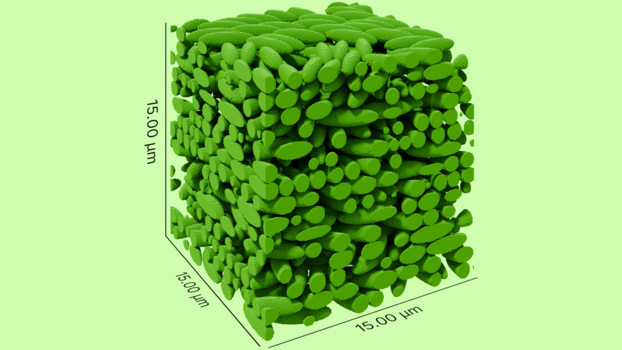
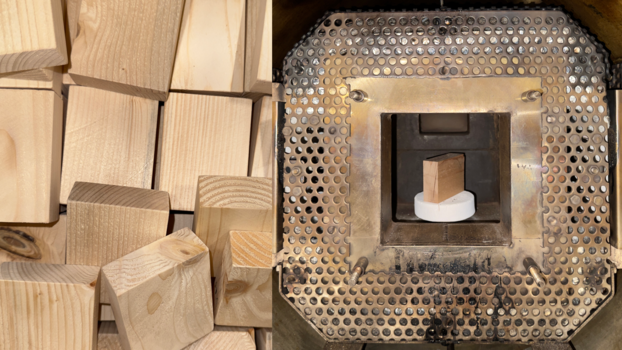
Structures and validation data come from experiments. We reconstruct pore networks from X-ray micro-computed tomography (µ-CT) of real materials – maltodextrin cakes, titanium felts, beech wood at successive stages of pyrolysis – rather than from idealized geometries. We observe processes in operation using neutron radiography and tomography, 4D X-ray tomography, lyomicroscopy, microfluidic model systems and infrared thermography. And we run experiments at technical scale, including our own microwave dryer and a microwave-heated packed-bed reactor.