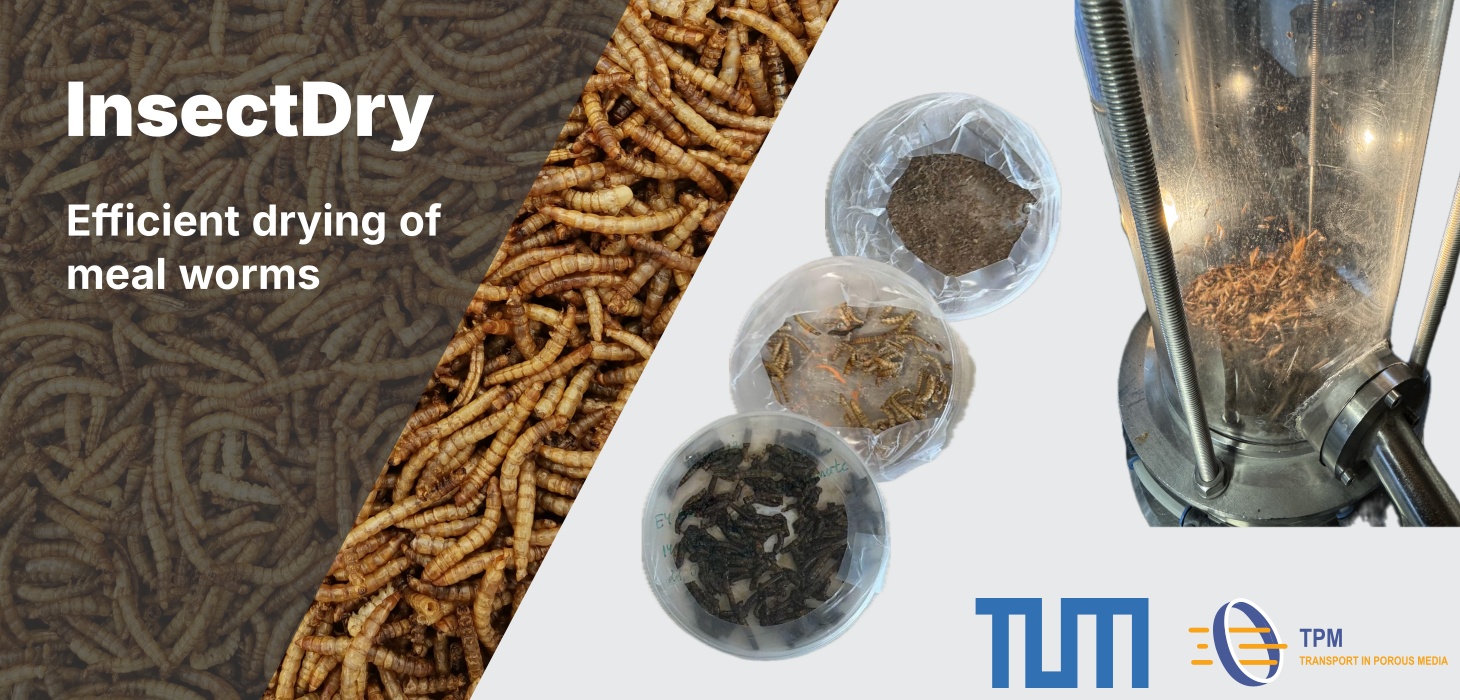
InsectDry – Efficient Drying of Mealworms
Abstract
The research project InsectDry investigates energy-efficient drying technologies for Tenebrio molitor, commonly known as mealworms, with the aim of preserving protein functionality while reducing process energy demand. Mealworms are considered a promising alternative protein source because they can be cultivated with comparatively low resource input, require little water, and offer high nutritional value with protein contents of approximately 25 – 75 %. However, drying is a key processing step for industrial use, as it strongly affects shelf life, product quality, protein functionality, and overall production costs.
Conventional hot-air drying often leads to reduced product quality and limited protein functionality, while vacuum freeze-drying is gentle but highly energy-intensive and therefore economically challenging. The project therefore focuses on two promising alternative drying methods: microwave drying and fluidized-bed drying. These technologies have the potential to improve process control, enhance product quality, and significantly reduce energy consumption.
A central objective of InsectDry is to understand how protein nativity depends on temperature and moisture content during drying. This relationship will be investigated experimentally, including differential scanning calorimetry measurements over a broad parameter range. The generated data will be used to develop kinetic models that describe protein denaturation and support the targeted design of drying processes.
Based on these findings, the project aims to establish a practical prediction and control tool that enables dynamic adjustment of drying parameters using readily accessible process data such as exhaust-air temperature and humidity. This approach will allow drying processes to be optimized simultaneously for product quality and energy efficiency.
The project is expected to provide important benefits for producers of mealworms and insect-based protein products, food manufacturers, and equipment suppliers, particularly small and medium-sized enterprises and start-ups. By improving product quality and lowering energy demand, InsectDry supports the development of competitive, sustainable, and high-quality insect protein ingredients for applications such as pasta, protein bars, bakery products, cheese alternatives, and other food innovations.
As an application-oriented practice partner, Wormm contributes the industrial perspective of mealworm production and processing to the project. The company helps InsectDry to align the research with practical requirements such as product quality, scalability, energy efficiency, and economic feasibility. Through this collaboration, the project results can be developed with a clear focus on industrial applicability and the sustainable processing of mealworm-based protein ingredients.
The project is coordinated by the Forschungskreis der Ernährungsindustrie e. V. and carried out by the Technical University of Munich, Professorship of Food Process Engineering, and Otto von Guericke University Magdeburg, Chair of Thermal Process Engineering.
Further information
Research partner
|
Prof. Dr.-Ing. Petra Först |
Technische Universität München Weihenstephaner Berg 1 |
|---|
Funding
This IGF project of the FEI is/was supported within the programme for promoting the Industrial Collective Research (IGF) of the German Federal Ministry for Economic Affairs and Energy (BMWE) on the basis of a decision by the German Bundestag.
- Project title: Effiziente Trocknung von Tenebrio molitor (Mehlwürmern) zur Erhaltung funktioneller Eigenschaften
- Project number: 01IF25217N
- Duration: 07/2026 - 12/2028
 |
 |
 |